Showing posts with label PPI. Show all posts

Monday, July 25, 2011

NUCLEAR POWER PLANT

NUCLEAR POWER PLANT
A nuclear power plant (NPP) is a thermal power station in which the heat source is one or more nuclear reactors.


The schematic arrangement of a nuclear power station is shown above.
The whole arrangement can be divided into following main stages.
(i)Nuclear Reactor (ii)Heat Exchanger (iii)Steam Turbine (iv)Alternator
(i)Nuclear Reactor
It is an apparatus in which nuclear fuel(U235)is subjected to nuclear fission.It controls the chain reaction that starts once the fusion is done.If the chain reaction is not controlled,the result will be an explosion due to the fast increase in the energy released.
A nuclear reactor is a cylindrical stout pressure vessel and houses fuel rods of Uranium moderator and control rods.The fuel rods constitute the fission materials and release huge amount of energy when bombarded with slow moving neutrons.The moderator consists of graphite rods which enclose the fuel rods.The control rods are of Cadmium and and are inserted in the reactor.Cadmium is strong neutron absorber and thus regulates the supply of neutrons for fission.When the control rods are pushed in deep enough,they absorb most of fission neutrons and hence few are available for chain reaction, which therefore stops.However,hence they are being withdrawn,more and more of these fission neutorns cause fission and hence the intensity of chain reaction is increased.Therefore by pulling out the control rods,power of nuclear reactor is increased,whereas by pushing them in,it is reduced.In actual practice,the lowering or raising of control rods is accomplished automatically acoording to the requiremen t of load.The heat produced by the reactor is removed by the coolant, generally a sodium metal.The coolant carries heat to the heat exchanger.
(ii)Heat Exchanger
The coolant gives up the heat to the heat exchanger which is utilised in raising the steam.After giving up heat,the coolant is again fed to the reactor.
(iii)Steam Turbine
The stean produced in the heat exchanger is led to the steam turbine througha valve.after doing a useful work in the turbine,the steam is exhausted to the condenser.The condenser condense the steam which is fed to the heat exchangerthrough feed water pump.
(iv)Alternator
The steam turbine drives the alternator which converts mechanical energy into electrical energy.The output from the alernator is delivered to the bus bars through tansformers,circuit brakers and isolators.

A nuclear reactor is a device to initiate and control a sustained nuclear chain reaction.


Tuesday, June 28, 2011

Thermal Power Station Lay-out

Thermal Power Station Lay-out

(courtesy:www.tneb.in/image/thermalblock.jpg)


Components of Thermal Power Station


Superheater : Most of the modern boliers are having superheater and reheater arrangement. Superheater is a component of a steam-generating unit in which steam, after it has left the boiler drum, is heated above its saturation temperature. The amount of superheat added to the steam is influenced by the location, arrangement, and amount of superheater surface installed, as well as the rating of the boiler. The superheater may consist of one or more stages of tube banks arranged to effectively transfer heat from the products of combustion.Superheaters are classified as convection , radiant or combination of these.


Condenser : Steam after rotating steam turbine comes to condenser.Condenser refers here to the shell and tube heat exchanger (or surface condenser) installed at the outlet of every steam turbine in Thermal power stations of utility companies generally. These condensers are heat exchangers which convert steam from its gaseous to its liquid state, also known as phase transition. In so doing, the latent heat of steam is given out inside the condenser. Where water is in short supply an air cooled condenser is often used. An air cooled condenser is however significantly more expensive and cannot achieve as low a steam turbine backpressure (and therefore less efficient) as a surface condenser. The purpose is to condense the outlet (or exhaust) steam from steam turbine to obtain maximum efficiency and also to get the condensed steam in the form of pure water, otherwise known as condensate, back to steam generator or (boiler) as boiler feed water.


Condensers are classified as (i) Jet condensers or contact condensers (ii) Surface condensers.


In jet condensers the steam to be condensed mixes with the cooling water and the temperature of the condensate and the cooling water is same when leaving the condenser; and the condensate can't be recovered for use as feed water to the boiler; heat transfer is by direct conduction.


In surface condensers there is no direct contact between the steam to be condensed and the circulating cooling water. There is a wall interposed between them through heat must be convectively transferred.The temperature of the condensate may be higher than the temperature of the cooling water at outlet and the condnsate is recovered as feed water to the boiler.Both the cooling water and the condensate are separetely with drawn.Because of this advantage surface condensers are used in thermal power plants.Final output of condenser is water at low temperature is passed to high pressure feed water heater,it is heated and again passed as feed water to the boiler.Since we are passing water at high temperature as feed water the temperature inside the boiler does not dcrease and boiler efficincy also maintained.


Economiser : Flue gases coming out of the boiler carry lot of heat.Function of economiser is to recover some of the heat from the heat carried away in the flue gases up the chimney and utilize for heating the feed water to the boiler.It is placed in the passage of flue gases in between the exit from the boiler and the entry to the chimney.The use of economiser results in saving in coal consumption , increase in steaming rate and high boiler efficiency but needs extra investment and increase in maintenance costs and floor area required for the plant.This is used in all modern plants.In this a large number of small diameter thin walled tubes are placed between two headers.Feed water enters the tube through one header and leaves through the other.The flue gases flow out side the tubes usually in counter flow.


Air preheater : The remaining heat of flue gases is utilised by air preheater.It is a device used in steam boilers to transfer heat from the flue gases to the combustion air before the air enters the furnace. Also known as air heater; air-heating system. It is not shown in the lay out.But it is kept at a place near by where the air enters in to the boiler.
The purpose of the air preheater is to recover the heat from the flue gas from the boiler to improve boiler efficiency by burning warm air which increases combustion efficiency, and reducing useful heat lost from the flue. As a consequence, the gases are also sent to the chimney or stack at a lower temperature, allowing simplified design of the ducting and stack. It also allows control over the temperature of gases leaving the stack (to meet emissions regulations, for example).After extracting heat flue gases are passed to elctrostatic precipitator.

Thursday, June 23, 2011

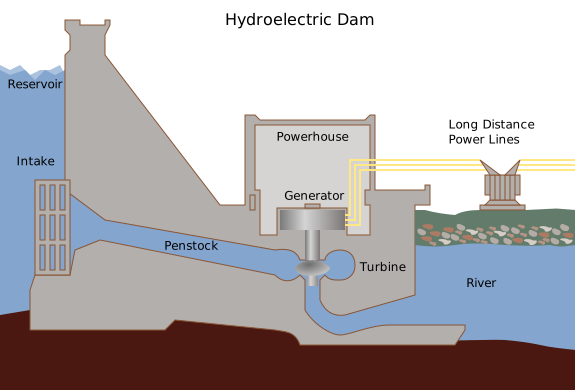
Hydro power plant Diagrams

Parts of hydro power plant


The first picture is of turbine and generator


The following picture shows the hydro electric power plant

(Thanks: 1.science.howstuffworks.com, 2.ga.water.usgs.gov, 3.mpoweruk.com)


Methods Of Power Generation


(COURTESY:http://www.leadership-exercises.net/methods-of-power-generation.php)
1. Solar power
– Solar power utilizes the solar’s immense power that can be converted to a different sort of power and that is electricity. There are solar collectors and solar panels that may accumulate the solar’s vitality to make electrical energy that can be distributed to any home. Solar power is renewable and it assists diminish polluting of the environment.The one draw back to that is the associated fee and the efficiency to provide energy.

2. Wind energy – This is another methodology of energy era that creates power. Wind generators can be constructed in locations where the wind is quite robust to generate electrical energy. Wind energy is also eco-friendly and it’s renewable. The only drawback to this is that it is restricted to windy places.

3. Geothermal energy – Geothermal energy makes use of underground steam that arrives from vents in volcanoes. Geothermal vegetation are made to produce electrical power. Geothermal vitality is abundant in locations where there are a lot of volcanoes and springs.

4. Hydro power – Hydro energy is without doubt one of the largest energy supply in the world. Virtually 70 percent of the earth utilizes hydropower to produce enough energy. Energy generation dams are constructed to produce electricity that can be distributed to totally different households.Though hydropower plants produce a large amount of power, it disrupts the natural ecosystem within its surrounding area. Other places may also be dried up as a result of water is being controlled inside the dam.

5. Fossil fuels – Fossil fuels like coal, oil and pure gas may also generate energy. Nations in the Middle East are rich in fossil fuels. The benefit of this type of energy source is it may produce numerous vitality hat can be utilized in energy vegetation cars and other machineries.The only set back to this is pollution. Fossil fuel is the number one producer of misuse gases that destroys our atmosphere. It is usually non-renewable that is why it is already depleting as of now.

6. Tidal energy. The powerful tide within the sea can be harnessed to provide energy and electricity. Although it’s viable, it’s quite rare for nations to set a tidal power plant. First, it is costly and secondly you need an enormous tide to produce sufficient energy.

7. Biomass – Biomass may be the reply to non-renewable resources to generate power. Specialists and scientist have been creating the potential of biomass energy to provide enough vitality for people to use.

8. Nuclear vitality – Nuclear vitality has its advantages and disadvantages. Since the discovery of nuclear fission, nuclear energy has been in demand to supply enough vitality and electricity. The draw back to this is the hazards it may give when crash occurs similar to the Chernobyl nuclear plant.These are the methods of power technology that can be utilized to have energy and electrical energy to make the lives of people simpler and better.


Tuesday, June 21, 2011

Power Plant Instrumentation

Today is the first class for this course. Very long back, I handled this course. This is an intersting course. In today's class, some introductions have to be given to the students about this course. Before that, need for studying this course has to be elaborated. As, the energy/power is an important consideration of today's life, we need to concentrate on two points; energy production and energy consumption. These two are very important points we have to look at.
This particular course is about energy generation/production. This course will deal about various generation methods, measurement & control procedures being followed in the power plants and various analysis methods (these are significant in controlling pollutions - environmental) process and products of power generation.
This subject has to be taught/learnt with the aspect that an engineer is more responsible in producing power with environmental/economical concern of our country.
The power crisis problem will not be solved only by increasing the number of power plants. To solve this problem we need to create an awareness among the pepole about the power conusmption.
Let us see the things one by one.